
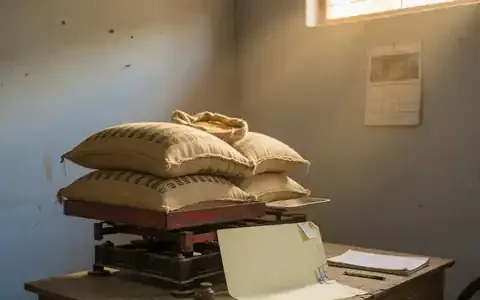
This one is a grain desk. Farmers bring paddy or wheat to a small commission counter beside a mandi road in Bihar or West Bengal. A clerk writes the weight. The payment goes later. It is not a named trader, and it is not a clinic, a coaching centre, or a hardware shop. Those were other problems. This desk had a different one, and it does not use invented tonnage, rates, or loss figures.
While the farmer is still in the yard
The load is on the scale. The clerk writes the name, the weight, the rate they just agreed, and where the farmer wants the money sent. If a figure is wrong, both of them are standing there. The slip can be fixed in front of the person it names. That is an open record, and it should be open.
After he has left
The next morning the same clerk can open the notebook, or the sheet on the counter computer, and change yesterday’s weight. The farmer is gone. The payment, when it leaves, follows the new figure. He may have a photo of the first slip on his phone. The desk has a cleaner number, and no second line that says what moved.
That is the case. Nobody stole a password. The listing on Maps was not the failure. A finished line stayed editable by the person who wrote it.
The rule they put on the desk
They did not start with a mandi app. They closed the slip before the farmer left the yard.
The slip needs the name, the weight, the rate, and the payment destination, plus a second initial from someone who did not write the first line. A family member who is already at the counter is enough. The point is a second pair of eyes at the moment the farmer can still see the paper.
If the weight is disputed the next day, they add a correction line. They do not scratch out the first weight. The farmer, the clerk, and the owner can all see both numbers and why the second one exists. A dispute needs the history. A tidy eraser hides it.
Writing the load and changing where the money goes are different decisions, even on a desk that does both. The clerk can record the account the farmer named in the yard. A later change to that account waits for the owner, or for whoever the owner has named. The person who types the slip should not be the only person who can redirect the payment after the farmer has gone home.
The sheet has to live where the owner can open it without asking the clerk for a password only the clerk knows. Sharing a computer for typing is ordinary. Keeping yesterday’s only copy inside a login the owner cannot use is the part that breaks the rule.
The same question, in a trade that is not grain
The useful part is the question, not the crop. Which action is still allowed after the other person has left?
A highway lodge can let the night manager change a booking and still refuse to let that same login change the bank account that receives the stay. A tailoring workshop can let someone mark a job finished and still refuse to let that person edit the rate after the customer has taken the clothes. A pharmacy counter can update what was sold and still refuse to let that login change the supplier’s payment account. A school office can record a fee received and still refuse to let the cashier rewrite yesterday’s receipt. The counter changes. The split does not.
A clinic where five people share one email is a different case again. There the question is who may sign in. Do not paste a login checklist onto a mandi, and do not paste a closed-slip rule onto a reception desk that has never weighed a bag. Pick the decision the business actually argues about.
What this desk does not prove
They can point at a closed slip. They cannot claim fewer disputes, a better rate, or a safer season. Those depend on the crop, the farmer, and the town. We do not publish a figure this desk cannot show from its own slips. They also left the signboard name as it is. Stuffing the Maps name with extra crop words would not have closed yesterday’s line.
For the wider habit of keeping a record someone else can still trust, see from paper to process and secure by design. The work on this desk is narrower than either of those: one line, closed while both people can see it.
Questions from the counter
Does a grain desk need new software before it closes a slip?
No. A paper slip can be closed: name, weight, rate, payment destination, and a second initial before the farmer leaves. Software can come later. It does not help if yesterday’s slip can still be rewritten by the person who wrote it.
Can the same clerk record the load and change where the farmer is paid?
The clerk can record the load, including the account the farmer named while he was there. A later change to that account waits for a second person, the owner or whoever the owner names. Recording a load and redirecting the money are different actions.
What if the farmer disputes the weight the next day?
Keep the closed slip, and write a new line for the correction. Do not erase the first weight. A dispute needs both numbers.